Pages

Wednesday, 11 December 2013

Barack Obama’s Full Speech at Mandela Memorial

Barack Obama’s Full Speech at Mandela Memorial
U.S. President Barack Obama delivered a powerful speech at former South African president Nelson Mandela’s memorial service:
To Graça Machel and the Mandela family; to President Zuma and members of the government; to heads of state and government, past and present; distinguished guests – it is a singular honor to be with you today, to celebrate a life unlike any other. To the people of South Africa – people of every race and walk of life – the world thanks you for sharing Nelson Mandela with us. His struggle was your struggle. His triumph was your triumph. Your dignity and hope found expression in his life, and your freedom, your democracy is his cherished legacy.
It is hard to eulogize any man – to capture in words not just the facts and the dates that make a life, but the essential truth of a person – their private joys and sorrows; the quiet moments and unique qualities that illuminate someone’s soul. How much harder to do so for a giant of history, who moved a nation toward justice, and in the process moved billions around the world.
Born during World War I, far from the corridors of power, a boy raised herding cattle and tutored by elders of his Thembu tribe – Madiba would emerge as the last great liberator of the 20th century. Like Gandhi, he would lead a resistance movement – a movement that at its start held little prospect of success. Like King, he would give potent voice to the claims of the oppressed, and the moral necessity of racial justice. He would endure a brutal imprisonment that began in the time of Kennedy and Khrushchev, and reached the final days of the Cold War. Emerging from prison, without force of arms, he would – like Lincoln – hold his country together when it threatened to break apart. Like America’s founding fathers, he would erect a constitutional order to preserve freedom for future generations – a commitment to democracy and rule of law ratified not only by his election, but by his willingness to step down from power.
Given the sweep of his life, and the adoration that he so rightly earned, it is tempting then to remember Nelson Mandela as an icon, smiling and serene, detached from the tawdry affairs of lesser men. But Madiba himself strongly resisted such a lifeless portrait. Instead, he insisted on sharing with us his doubts and fears; his miscalculations along with his victories. “I’m not a saint,” he said, “unless you think of a saint as a sinner who keeps on trying.”
It was precisely because he could admit to imperfection – because he could be so full of good humor, even mischief, despite the heavy burdens he carried – that we loved him so. He was not a bust made of marble; he was a man of flesh and blood – a son and husband, a father and a friend. That is why we learned so much from him; that is why we can learn from him still. For nothing he achieved was inevitable. In the arc of his life, we see a man who earned his place in history through struggle and shrewdness; persistence and faith. He tells us what’s possible not just in the pages of dusty history books, but in our own lives as well.
Mandela showed us the power of action; of taking risks on behalf of our ideals. Perhaps Madiba was right that he inherited, “a proud rebelliousness, a stubborn sense of fairness” from his father. Certainly he shared with millions of black and colored South Africans the anger born of, “a thousand slights, a thousand indignities, a thousand unremembered moments…a desire to fight the system that imprisoned my people.”
But like other early giants of the ANC – the Sisulus and Tambos – Madiba disciplined his anger; and channeled his desire to fight into organization, and platforms, and strategies for action, so men and women could stand-up for their dignity. Moreover, he accepted the consequences of his actions, knowing that standing up to powerful interests and injustice carries a price. “I have fought against white domination and I have fought against black domination,” he said at his 1964 trial. “I’ve cherished the ideal of a democratic and free society in which all persons live together in harmony and with equal opportunities. It is an ideal which I hope to live for and to achieve. But if needs be, it is an ideal for which I am prepared to die.”
Mandela taught us the power of action, but also ideas; the importance of reason and arguments; the need to study not only those you agree with, but those who you don’t. He understood that ideas cannot be contained by prison walls, or extinguished by a sniper’s bullet. He turned his trial into an indictment of apartheid because of his eloquence and passion, but also his training as an advocate. He used decades in prison to sharpen his arguments, but also to spread his thirst for knowledge to others in the movement. And he learned the language and customs of his oppressor so that one day he might better convey to them how their own freedom depended upon his.
Mandela demonstrated that action and ideas are not enough; no matter how right, they must be chiseled into laws and institutions. He was practical, testing his beliefs against the hard surface of circumstance and history. On core principles he was unyielding, which is why he could rebuff offers of conditional release, reminding the Apartheid regime that, “prisoners cannot enter into contracts.” But as he showed in painstaking negotiations to transfer power and draft new laws, he was not afraid to compromise for the sake of a larger goal. And because he was not only a leader of a movement, but a skillful politician, the Constitution that emerged was worthy of this multiracial democracy; true to his vision of laws that protect minority as well as majority rights, and the precious freedoms of every South African.
Finally, Mandela understood the ties that bind the human spirit. There is a word in South Africa- Ubuntu – that describes his greatest gift: his recognition that we are all bound together in ways that can be invisible to the eye; that there is a oneness to humanity; that we achieve ourselves by sharing ourselves with others, and caring for those around us. We can never know how much of this was innate in him, or how much of was shaped and burnished in a dark, solitary cell. But we remember the gestures, large and small – introducing his jailors as honored guests at his inauguration; taking the pitch in a Springbok uniform; turning his family’s heartbreak into a call to confront HIV/AIDS – that revealed the depth of his empathy and understanding. He not only embodied Ubuntu; he taught millions to find that truth within themselves. It took a man like Madiba to free not just the prisoner, but the jailor as well; to show that you must trust others so that they may trust you; to teach that reconciliation is not a matter of ignoring a cruel past, but a means of confronting it with inclusion, generosity and truth. He changed laws, but also hearts.
For the people of South Africa, for those he inspired around the globe – Madiba’s passing is rightly a time of mourning, and a time to celebrate his heroic life. But I believe it should also prompt in each of us a time for self-reflection. With honesty, regardless of our station or circumstance, we must ask: how well have I applied his lessons in my own life?
It is a question I ask myself – as a man and as a President. We know that like South Africa, the United States had to overcome centuries of racial subjugation. As was true here, it took the sacrifice of countless people – known and unknown – to see the dawn of a new day. Michelle and I are the beneficiaries of that struggle. But in America and South Africa, and countries around the globe, we cannot allow our progress to cloud the fact that our work is not done. The struggles that follow the victory of formal equality and universal franchise may not be as filled with drama and moral clarity as those that came before, but they are no less important. For around the world today, we still see children suffering from hunger, and disease; run-down schools, and few prospects for the future. Around the world today, men and women are still imprisoned for their political beliefs; and are still persecuted for what they look like, or how they worship, or who they love.
We, too, must act on behalf of justice. We, too, must act on behalf of peace. There are too many of us who happily embrace Madiba’s legacy of racial reconciliation, but passionately resist even modest reforms that would challenge chronic poverty and growing inequality. There are too many leaders who claim solidarity with Madiba’s struggle for freedom, but do not tolerate dissent from their own people. And there are too many of us who stand on the sidelines, comfortable in complacency or cynicism when our voices must be heard.
The questions we face today – how to promote equality and justice; to uphold freedom and human rights; to end conflict and sectarian war – do not have easy answers. But there were no easy answers in front of that child in Qunu. Nelson Mandela reminds us that it always seems impossible until it is done. South Africa shows us that is true. South Africa shows us we can change. We can choose to live in a world defined not by our differences, but by our common hopes. We can choose a world defined not by conflict, but by peace and justice and opportunity.
We will never see the likes of Nelson Mandela again. But let me say to the young people of Africa, and young people around the world – you can make his life’s work your own. Over thirty years ago, while still a student, I learned of Mandela and the struggles in this land. It stirred something in me. It woke me up to my responsibilities – to others, and to myself – and set me on an improbable journey that finds me here today. And while I will always fall short of Madiba’s example, he makes me want to be better. He speaks to what is best inside us. After this great liberator is laid to rest; when we have returned to our cities and villages, and rejoined our daily routines, let us search then for his strength – for his largeness of spirit – somewhere inside ourselves. And when the night grows dark, when injustice weighs heavy on our hearts, or our best laid plans seem beyond our reach – think of Madiba, and the words that brought him comfort within the four walls of a cell:
It matters not how strait the gate,
How charged with punishments the scroll,
I am the master of my fate:
I am the captain of my soul.
What a great soul it was. We will miss him deeply. May God bless the memory of Nelson Mandela. May God bless the people of South Africa

Monday, 9 December 2013

Buhari, APC are no threats, says Shema

Buhari, APC are no threats, says Shema


Katsina State Governor Ibrahim Shema yesterday said the All Progressives Congress (APC) will not pose any threat to the Peoples Democratic Party (PDP) in 2015.
Speaking with State House correspondents in Abuja, he said the involvement of former presidential candidate, Muhammad Buhari, with the opposition party would not be a threat.
The governor said the Peoples Democratic Party (PDP) government had touched the lives of the people and that would be its advantage in 2015.
He said: “I believe in service and I believe in God. You know my business is that of the PDP and that of the people and leaders of the PDP. That’s how it starts and that’s how it ends.
“I don’t take time discussing other parties or other individuals. My party is doing well and we will even do more for Nigerians.
“I am confident because we have done a lot of work. Go there and see for yourself. Politics is about service, it is about the fear of God, it is about managing resources, human and material.
“To the best of my ability, we are doing just that in Katsina and we are confident that with the services we have delivered to our people, God will not let us down.
“I tell you, my business is to strengthen my party; to continue to work to build bridges and to reduce the level of the problems we are having.
“Any human organisation the size of the PDP will have challenges anywhere in the world. Even in families, the large extended African families have challenges.
“So our size demands challenges and demands all hands to be on deck. But the challenges are not insurmountable because PDP remains the only platform that is owned by all Nigerians, it doesn’t belong to any section of the country or individual, it belongs to all Nigerians. There is no section, no religion, no tribe that is not in PDP.”
Source: The Nation

Equal (life) and justice • Letter to Senate

Equal (life) and justice • Letter to Senate By Lawal Ogienagbon


To an extent, Shakespeare was right. Often times when commoners die, they pass away unsung, it is only in rare cases that their death make the front page. When that happens, you know immediately that something extra – ordinary must have happened. Whatever it is, it is usually not palatable. So, it was on September 20 when eight persons were killed in Apo, a suburb of the Federal Capital Territory (FCT) in Abuja during a raid by a combined team of soldiers and State Security Service (SSS) officials.
The outcry over the Apo killings was deafening not because it was the second time in eight years that such a thing was happening in the capital city, but because it was becoming routine for our security operatives to wittingly kill their compatriots. It seems our security operatives take delight in killing their civilian brethren just for the fun of it. At the drop of a hat, they are ready to shoot to kill without taking into consideration the consequences of their action.
They are apparently quick on the trigger because they know they will get away with their despicable act. All they need do is to tag their victims robbers. And in these days of Boko Haram, their alibi is made stronger. They know that once anybody is associated with that group, he will not enjoy sympathy from the people. The SSS was counting on such support when it went to town over why it embarked on the dawn raid along with soldiers on defenceless civilians living in an uncompleted building in Apo that September.
Most of the inhabitants were doing menial jobs. Some were commercial tricycle operators, some shoe shiners, some washer men and so on and so forth. Because of the acute accommodation problem in Abuja, they were lucky to find such a place to hide their heads for a paltry N200 or N300 per night. Undoubtedly, in a situation like that, it is quite easy for those who do not mean well for the country to find their way into such a place. It is also easy for such evil – minded people to get new converts there. But this is not to say that everybody there will harbour evil intentions or will be criminals.
Unfortunately, this was how the SSS labelled all the occupants of the building before it set out on its mission in September. With such a mindset, the security operatives went to Apo to kill, no more no less. It was a predetermined action because they had already made up their minds about those poor fellows. As a layman in security matters, I have not ceased wondering whether the rules of the game allow security men to behave in such irrational manner when they are not sure of how to classify their target.
Do you label the target a criminal before or after an operation? How do you know that he is a criminal without interrogating him? Do you label someone a criminal by the company he unintentionally keeps or for sharing unknowingly the same quarters with suspected criminals? In this instant case, the SSS went to the Apo building based on what it called the intelligence it received that Boko Haram suspects were hibernating there. All the security men had in their heads as they went for the mission was that they were going after Boko Haram. Since the fear of Boko Haram is the beginning of wisdom, they were prepared to kill.
In their haste to shoot anybody they came across, they forgot their rules of engagement. No matter the intelligence they might have gathered, they should have had it at the backs of their minds that those they were going after were civilians, whether Boko Haram or not. If they chose to forget that, our senators should not have made the same mistake. The SSS men may have a score to settle with Boko Haram and other insurgents, going by what happened to some of their colleagues in the hands of the Ombatse cult in Nasarawa State a few months ago, but that is not enough reason for them to behave like those people.
If Boko Haram and other militias are losing their heads at will, our security operatives are expected to keep theirs to show that they have what it takes to do their kind of job. If we remember we got to this pass because the police lost their cool and killed Muhammed Yusuf, the Boko Haram leader, after he was arrested and handed over to them by soldiers in 2009. If soldiers could do that despite being trained to kill, why couldn’t the police, that are trained to be civil, restrain themselves in like manner? This is why I am shocked that some senators could defend the SSS’ action in killing in cold blood the Apo 8 on September 20.
In defending the SSS, Chairman of the Joint Senate Committee on National Security and Intelligence and Judiciary, Human Rights and Legal Matters, Senator Mohammed Magoro, who retired from the army as a general, said majority of the occupants of the Apo building cohabited with Boko Haram elements ”unknowingly”. In one breath, he described the SSS raid as ”necessary and timely” and in another, he said :”The conduct of the operatives leaves much to be desired”. Magoro was not done in his paradox of contradictions. Hear him : ”The death of eight people was not a case of extra – judicial killing but the action of an hastily executed operation”.
I pray when you hastily execute an operation, what do you get? By now, with what happened in Apo on September 22, we all know the answer. It is sad that the Senate adopted the committee’s report. It is obvious that it did so because it felt that the lives of some of its principal officers were at risk, with the so – called Boko Haram elements as their neighbours. That is a wrong way to look at the issue. The Senate should have called the SSS to order instead of giving it the latitude to do something worse in future. The Senate, by its action, has unwittingly armed all our security agencies to engage in extra – judicial killing under the guise of ferreting out suspected criminals.
The Senate should remember that a life is a life whether that of a prince or pauper. If the Senate deems it fit to protect its own why can’t it extend the same gesture to the commoners who voted its members to power. By its action, what the Senate is telling us is that we are only good at voting for them, but do not deserve to be protected when our lives are in danger from the very people we pay to secure us. May I commend to the Senate, these lines from Justice Chukwudifu Oputa’s verdict in a Supreme Court case in 1986 : ”In our system, it is better that nine guilty persons escape than that one innocent man is condemned”.
Neither the Senate nor SSS gave the innocent in the September 20 tragedy the benefit of doubt. The SSS killed them and the Senate sanctioned the extra – judicial killings under the guise of fighting terrorism. Was he Magoro panel asked to look into acts of terrorism or to probe the Apo killings?

On the national conference

On the national conference By Jide Osuntokun


The calling for a national conference by the President in his recent independence broadcast has generated a lot of comments. Some have wondered why the sudden conversion of the President and the president of Senate to the idea of a national conference when for the past three years he has resisted the idea. Critics of the President have suggested that this is a political move on his part to manipulate the politics of Nigeria towards his re-election in 2015. Some even see some sinister move on his part to grant resource control through the conference to the oil-producing South-south where he comes from. On the other hand, some have hailed the action of the President on the grounds that it is never too late to change. After all, Saul who was a persecutor of Christians later became Paul the Apostle. Those who have called for conference for many years to decide and determine the future of Nigeria have also hailed the President for acceding to their request. The situation unfortunately, has now been complicated by the APC’s decision to boycott the conference. I’m totally against this call for boycott. It is better to discuss our affairs and to try and find ways and solutions to complex political situations than bury our heads in the sand and think that the problems would go away. This may not be the intended purpose of the boycott but the result will tend to validate that intention.
I personally believe that we must explore and exploit all ways and avenues to force the hands of government to change course in this country or we would all be consumed by the Fire Next Time. I believe a conference can develop its own internal dynamics just like any revolution and those with secret agenda would not be able to contain it. This should be the tactic all those who want something concrete from the conference should adopt. Of course, critics are right to say that whatever is decided should not go to the National Assembly whose members were largely rigged in, but that it should be subject to a national referendum and that whatever “we the people” decide should become the supreme law. The question of two sovereigns at the same time should not arise. Once the referendum has passed, the President through a presidential proclamation would bring the resolution into law and call for new elections into the various organs that the conference would have decided upon. If the APC sticks to its guns that it would not participate, what we would then have is a document produced not by the first eleven, but by people on the reserve seats. This would not be in the interest of the country. I think the APC should think all over it again and go to the conference determined to take control of the discussion rather than standing outside the conference and expecting things to go wrong.
Beatrice and Sydney Webb of the famous Fabian school believed that “it is better for revolutionaries to permeate political bodies from within rather than to stand outside them shouting at the deaf”. I have always been guided by the Fabian theory and practice and I think all political animals should be guided by them. Our country can be a great country. The economic fundamentals of this country are solid. We’ve got the resources and the people. What is lacking is leadership and determination on the part of leadership to force our nation to realise its full potentialities. We should not wait until this house of Nigeria has fallen before we begin to salvage it. We now have an opportunity in the national conference and I believe we should seize the moment.
Events in other parts of the world should show us that there is no point sitting on the fences. We should look at countries like Greece, Egypt, Pakistan, which are collapsing into irrelevance and chaos. We are just too many, 170 million of us for experimentation, because if our country were to collapse, where would 170 million people go as refugees? Prevention is better than cure. We have an opportunity to prevent sure political debacle and economic disintegration through this conference and deciding to take necessary precaution to avoid tragic end to the Nigerian project. This is not the time to play politics; it is the time for statesmanship. All Nigerians should support discussion at the national conference and taking positive decisions to change the course of our national development. If after we would have given our support, the political leaders in government today decides to subvert the wishes of the people, then the consequences and the blood of our people would be on their heads.
Choosing those who would represent the people may be problematic, but I think we should use the current population to decide the representation of the states. Critical stakeholders like labour, universities, and even students should be represented by their leaders. Government in its wisdom may also want to select some leaders of the two main monotheistic religions of Christianity and Islam to represent special interest. This idea of people representing ethnic and tribal entities is totally unnecessary because after all whatever ethnic or tribal groups that Nigeria may have are already represented at state levels.
One of the issues that this conference should be seized with would be the whole question of revenue allocation, fiscal federalism or resource control as it is popularly known. There should be discussion on consumption and value-added taxation. There should also be discussion on the system of government itself. It has become obvious to many Nigerians that the present presidential system of Nigeria is too expensive and concentrates too much power in the hands of government executives at local, state and federal levels. We should also raise the issue of devolution of power and resources from the federal to the states and local governments. We must also settle forever that it is the states coming together to form the federal government and not the federal government creating states. In other words, there can be no room for federal intervention in local government creation and financing. That should belong to the states’ jurisdiction. So the talk of three-tier system of government is an aberration. We can only have states and the federal government relating in a mutually beneficial way. We should also be discussing whether to go back to parliamentary system of government and cabinet government of collective responsibility and where members of the cabinet would also be members of the house and the President or Prime Minister would be the leader of the majority party in the house and would be subjected to routine questions and enquiry about reasons for government action by a virile opposition in the house. This is of course a cheaper system of government, and the disconnect which currently exists between the executives and the legislatures would be done away with.
The present concentration of power on a presidential Poobah, which makes our president the most powerful of all presidents in the world would undergo radical transformation. The jurisdiction of each level of government would also be discussed and agreed upon to eliminate the anomaly of a federal Ministry of Agriculture when the federal government has no land of its own apart from Abuja. The starting point of the discussion should be the independence constitution of 1960 which was the only constitution that our political leaders agreed upon without guns pointing to their heads. These are the issues which must be discussed and agreed upon so that the energies of our people can be released for positive development of the sciences and the arts and so that we can stop talking about constitutions while other countries of the so called developing world are already sending probes to Mars

Governors to raise nine questions on economy

Governors to raise nine questions on economy


Governors are disturbed by the state of the economy, which has remained hazy to them.
They are to raise nine issues on Thursday at the meeting of the National Economic Council (NEC), which has not been convened in the past three months.
Many states have complained of being shortchanged in their monthly allocations. Some have been borrowing to pay their workers’ monthly wages, The Nation learnt at the weekend.
Vice-President Namadi Sambo has summoned a NEC meeting, following the governors’ compliant that they are being kept in the dark about the economy’s health.
The nine issues are:
•Is it true that $50billion was unremitted to the Federation Account? Where is the money?
•Is Nigeria is broke or not;
•Why was the NEC consulted before 2014 Budget was presented to the National Assembly;
•How much has Nigeria earned from its oil sales in 2013 and what percentage of the budget is funded by these receipts?
•Is it really true that $5b is missing from Excess Crude Account
•How much oil does Nigeria produce daily?
•Is the benchmark price for oil in the 2013 budget is $79?
•Is it a fact that crude oil was sold at prices that hovered about $110 per day throughout the year?
Sections 18 and 19 of the 1999 Constitution states: “The Economic Council shall comprise the following members -
(a) the Vice-President who shall be the Chairman;
(b) the Governor of each State of the Federation; and
(c) the Governor of the Central Bank of Nigeria established under the Central Bank of Nigeria Decree 1991 or any enactment replacing that Decree.
“The National Economic Council shall have power to advise the President concerning the economic affairs of the Federation, and in particular on measures necessary for the co-ordination of the economic planning efforts or economic programmes of the various Governments of the Federation.”
The governors have not been happy that the Presidency has kept NEC meeting in abeyance for about three months.
According to sources, the governors had initially suspected that the delay in convening the meeting had to do with the Peoples Democratic Party (PDP) crisis, but they later discovered that it had to do with the state of the economy.
A governor said: “We are really unhappy that the VP has refused to convene NEC meeting for three months running, which is in breach of the 1999 Constitution.
“The excuse from the Presidency for shifting the meeting has been that there is no money in the treasury and it would not want the governors to take it to task on it.
“Our position is that this is a constitutional breach because we are expected to meet monthly.”
Another governor, who also pleaded not to be named, said: “It is so sad that the Presidency forwarded the 2014 Budget to the National Assembly without consulting the NEC. This is an aberration.
“They refused to summon NEC meeting so that we will not raise questions.”
It was gathered that following pressure from governors on the state of the nation’s economy, Sambo fixed a NEC meeting for Thursday.
A governor said: “We got a belated notice to come for NEC meeting on Thursday. I am unhappy because we had longed for the meeting in the last three months.
“However some of us have met and the NEC will enable us to ask nine questions from the Federal Government.
“These nine questions include some of those Governor Rotimi Amaechi had put in the public domain.”
Since September 23, states have been experiencing shortfall as the monthly Federal Allocation and Appropriation Committee (FAAC) was aborted twice because of lack of cash to share.
Oil production has been between 1.9m and 2.2.m barrels per day instead of the projected 2.5m barrels per day.
At a stage, Finance Minister Dr. Ngozi Okonjo-Iweala, said it was a bit difficult to pay state government allocations in full.
But the Director-General of Budget Office, Mr. Bright Okogwu and his colleague, the Accountant-General of the Federation, Mr. Jonah Otunla, said: “Nigeria is not broke but it is having cash flow problems.”
In Akwa Ibom State, the Commissioner for Finance, Mr. Bassey Akpan said the state government secured a loan of N80 billion from Standard Chartered Bank of London in order to meet its obligations.
In Benue State, Teachers have been on strike in the last one month over non-payment of minimum wage.
A senior government official in Kaduna State said last night that the shortfall was affecting government activities in the state ‘tremendously.”
He said: “I must tell you that the shortfall is affecting us greatly. You know that there are so many things that are at a standstill at the moment. It is because of the shortfall that this is happening,
“You see people don’t know what is happening and so it is easy for them to criticise from outside. But when you get into the system, you discover that things are different.
“Actually, Edo State Governor Adams Oshiomhole has put the whole thing in proper perspective. The states are suffering from the shortfall. But it is easier for him to speak out because he is from the opposition. But things are not easy for us at all”.
In spite of that, the aide said the government is trying its best to ensure that workers’ salaries are not affected.
Kano State Commissioner for Budget and Planning Alhaji Yusuf Bello Dambata said the state had been taking ingenious action to beat the shortfall.
“We are trying to meet our promises to the people by blocking leakages.
“We’ve intensified internally generated revenue and cut cost of governance.
An Akwa Ibom Government House source, who preferred anonymity, explained that the effects of shortage in allocation from the federal government is affecting urban local government areas where are more concentration of primary schools.
According to him, in Uyo local government area, due to the large concentration of primary schools, after deducting salaries of the primary school teachers nothing is left to pay salaries of more than 600 members of staff.
His words: “Presenting, Uyo local government area owes its members of staff two months salaries. That of October and November has not been paid. The workers are not even sure of getting December salary.”
Lagos State Governor Babatunde Fashola faulted the distortion in revenue allocation.
He said: “We expect that as a country, we cannot continue to have this distortion in revenue collection and projection where the largest source of revenue comes from a single item. What it simply means is that we use revenue from our Internally Generated Revenue (IGR) that we should have used to pay contractors to keep the public service going. So, that distorts so many things.”

ASUU’s deadlocked strike

ASUU’s deadlocked strike By Emeka Omeihe
When President Jonathan engaged the Academic Staff Union of Universities (ASUU) on their five months old strike, there was general optimism that the end to the dispute was in sight. After about 13 hours of negotiations between the executives of ASUU, leaders from the Nigerian Labor Congress NLC and Trade Union Congress TUC, key decisions were said to have been evolved to end the strike.
As part of the understanding, ASUU undertook to present the resolutions to its National Executive Committee NEC and report back to the federal government. The union subsequently came up with some conditions which it wanted the government to endorse for the resolutions to be binding and the strike called off.
These included the depositing of the N200billion revitalization fund for public universities in the Central Bank of Nigeria (CBN) and subsequent disbursement to the benefiting universities within two weeks; inclusion of the non-victimization clause in the agreement and insistence that the resolutions be signed by the government.
But the federal government saw these as entirely new demands and evidence that ASUU was up to sabotage all efforts at sorting issues. It therefore called for broke directing all Vice Chancellors of federal universities to re-open them immediately and threatened to sack all lecturers who defy this order by failing to report and sign the attendance register by last Wednesday.
ASUU is adamant insisting that the strike will continue in view of the turn of events. It has argued that the letter it wrote to the president through the supervising minister of education did not amount to new demands. According to the union, the N200 billion revitalization fund as contained in the government white is meant for 2013 and as such its demand that it should be disbursed within this time frame is nothing new. Similarly, it argued that the non victimization clause is a universal practice while the insistence that the resolutions be signed by both parties is a requirement of all agreements.
As things stand, the end to the strike is not in sight. There is every indication that the toughened positions of both parties might worsen matters. Thus the education system which has been lying prostrate these five months will continue to suffer further devastation as the strike lingers. The federal government and ASUU are in mutual recrimination as to who takes the blame for the current impasse. And the court of public is expected to give a verdict on the matter. Whether the verdict of the public will suffice to end the strike is a different kettle of fish altogether.
The key issue here is whether the three items contained in ASUU’s letter to the president constitute new conditions and whether ASUU was right to have made those demands. On the other hand, even if they were new demands, was it also proper for the government to have reacted in the way and manner it did? ASUU does not see them as new demands on the grounds of the reasons stated above. But that is exactly where it did not get the matter right. It does not consider asking the president to remit the N200 billion revitalization funds to the CBN and disburse same to benefiting universities within two weeks as a new condition. This is at best laughable. If it is not a new condition why did the union come up with it at the last minute? And why was it not raised during their meeting with the president? And if the non victimization clause is a universal practice as ASUU has argued, it should have been taken for granted. It wants all the decisions reached to be signed. What is not clear is whether it is the president with whom they sat in negotiation they want to sign that document. If it is so, they must have gotten the matter wrong. Discussions with the number one citizen of any country are not something to be trivialized. The impression one gets from all these is that the union does not trust the president. That is very unfortunate indeed. By giving the impression that the president cannot be trusted and then requiring him to sign the document, the ASUU leadership conducted themselves as if they have no respect for that office irrespective of whoever occupies it. The very fact that the president undertook personally to negotiate with them was enough for them to have given him the benefit of doubt. They should have deferred to him and watch out for the eventual outcome. But to now begin to insist that the president must deposit the money in the CBN and disburse same within two weeks is enough to ruffle shoulders. Things do not necessarily work out that way.
The impression one gets from the position of ASUU is that it want to win all. Zero sum game option in decision theory goes with fatal consequences. And as can be gleaned from the impasse, it has turned out a monumental calamity at a time hopes were high that the strike was about to end.
It is however, a different thing altogether whether the response of the government was the most appropriate in the circumstance. The government went to the extreme in its reaction to the new demands of the union. There are other ways the matter could have been handled without bringing about the current pass. The net effect of the action is the continuation of strike thus defeating the whole idea of getting our universities back to the classroom. It will not serve the cause of our universities better.
But central to the constant strikes in our universities is the issue of funding. It is not enough for the government to make commitments to fund the universities adequately. Neither will disbursing the agreed sum be the end to the poor funding of the universities. The truth of the matter is governments both federal and state are increasingly finding it difficult to fund the universities in the current form they are run. University education is very expensive. The government knows this. ASUU and the general public are not unaware of this also.
But for some inexplicable reasons bothering on political expediency, the federal government is yet to muster the necessary courage to be decisive on the introduction of school fees in the universities. That is the crux of the matter. It is not that the government is not willing to introduce such fees. It is afraid of the backlash of the policy given public perception of the waste and unabated corruption in public places. Our people see free university education as the only way to benefit from the enormous resources nature bestowed on this country bountifully.
That has been the problem. But for how long shall we continue with the rot in our universities on account of government’s inability to fund them adequately? The time has come for the government to rise to the challenge that it can no longer fund the universities solely. It is better we charge some fees and provide quality university education than allow the current drain in our foreign exchange on account of the high number of our citizens that study outside this country. Already some state universities have risen to this challenge by charging school fees like the private ones. Ironically, some of these fee paying state universities are also in the strike for very hazy reasons. And if one may ask, what is their business in this strike? Why should they deny children who have paid for their education access to it? Or are they also hoping to get part of the revitalization fund meant for federal universities? Such state governments must order the teachers back to classes now.

Sunday, 8 December 2013

Pics Post: Nelson Mandela's Life In History Pictures + His Remarkable Legacy


1918–1943: Early Years Continue.........


Nelson Rolihlahla Mandela is born on July 18, 1918, in the village of Mvezo, in South Africa’s Eastern Cape. The son of a Xhosa tribal chief, Mandela spends his early years preparing to inherit his father’s role of privy councillor to the Thembu kings, attending a Methodist missionary school and learning to read and write at an early age. He attends a prestigious black African boarding high school and continues on to the elite Fort Hare University, but drops out after his first year in December 1940 in order to move to Johannesburg to escape an arranged marriage. He spends three years working in a law firm, during which time he joins the African National Congress political party and becomes involved in the growing South African nationalist movement. 1943–1948: Law Student


Oliver Tambo and Nelson Mandela
Mandela enrolls at the University of Witwatersrand to obtain a law degree, pursuing his studies with his high school friend (and future legal partner) Oliver Tambo. During this time, he joins the ANC, and after years of frustration with the party’s leadership, in 1947 Mandela founds the African National Congress Youth League, of which he is elected secretary.


An apartheid notice on a beach near Capetown, denoting the area for whites only
The National Party of South Africa wins the 1948 general election by advocating a policy of apartheid, meaning “apartness.” Building on years of discrimination against blacks, the National Party adopts apartheid as a way to preserve white supremacy. The system classifies people as either white, Bantu (black), colored (mixed race), or Asian and severely limits freedoms based on race. For example, anyone who is not white is prohibited from voting, all races have separate living areas and schools, blacks are required to carry travel passes at all times, and only whites control the legal system.


1951–1952: From Lawyer to Activist
Mandela is elected president of the ANC Youth League in 1951. Although he failed to obtain his degree from law school, Mandela passes the qualifying exam required to practice as an attorney in South Africa and Mandela and Oliver Tambo open the first black law firm in South Africa in Johannesburg in 1952. In June, Mandela leads a campaign of civil disobedience against the country’s racist apartheid laws. He and 19 others are arrested for their role in the “Defiance Campaign” and are given a suspended prison sentence.
1961: “Spear of the Nation”


Mandela delivers remarks in this undated photo from the 1960s
Spurred by escalating police brutality against peaceful protestors, the ANC, still active despite being outlawed by the government in April 1960, decides to form an underground guerrilla military wing called Umkhonto we Sizwe (Spear of the Nation). Mandela, who is now vice president of the ANC, is appointed the group’s first leader.
1962–1990: Life in Prison


The cell where Nelson Mandela lived for 18 years
Mandela leaves South Africa illegally in January 1962 and is caught and sentenced to five years in prison upon his return in July. In 1963, the imprisoned Mandela ismade to stand trial for sabotage and treason with nine of his comrades after a police raid of an ANC hideout uncovers evidence against him. On June 11, 1964, Mandela and seven others are convicted and sentenced to life imprisonment. He is sent to Robben Island, where he serves the first 18 of his 27 years in prison.
Violence on both sides escalates during Mandela’s years behind bars. During this time, he becomes an international symbol of South Africa’s black nationalist movement and resistance to apartheid. In 1985, then-President P.W. Botha offers to free Mandela if he publicly denounced violence as a weapon against apartheid.Mandela refuses and tells the government to get rid of apartheid and grant blacks political rights.


February 1990: Freedom

Mandela and his (second) wife Winnie Madikizela are greeted by large crowds as they leave the prison grounds
Newly elected president F.W. De Klerk legalizes the ANC, relaxes apartheid laws, and orders the release from jail of Mandela and the other political prisoners who were convicted with him. Mandela walks out of prison a free man on Feb. 11, 1990. After 27 years, he has become a fig­ure of myth­ic pro­por­tions among South Afric­an blacks, and his freedom is cause for national celebration. Mandela is known to most in the country as “Madiba,” his clan name.
1990: Peace Talks

South Africa’s President Frederik Willem de Klerk (left) and Mandela walk to address the press about their negotiations to end apartheid on May 9, 1990
Two months after his release, Mandela meets with President F.W. de Klerk in what will become the first of many meetings concerning the end of apartheid and the establishment of a truly democratic government. In August 1990, the ANC agrees to renounce violence in exchange for the release of all remaining political prisoners.
1991: President of the ANC

Mandela is elected president of the African National Congress on July 5, 1991, in the first legal gathering of the organization in South Africa in more than three decades. Representing the ANC, Mandela negotiates with de Klerk, members of the governing National Party, and other South African political organizations toward the country’s first multiracial elections. It proves a difficult task — negotiations were often strained. 1993: Nobel Peace Prize
Mandela and de Klerk are awarded the Nobel Peace Prize on Dec. 10, 1993, for their efforts to bring stability, equality, and true democracy to their country. As a result of their joint leadership, the remaining apartheid laws are repealed and a date is chosen for South Africa’s first open elections. April 1994: A Historic Election

Mandela smiles broadly April 27, 1994, in Oshlange, black township near Durban, as he casts his historic vote
On April 26, 1994, more than 22 million South Africans turn out to cast ballots in the country’s first multiracial parliamentary elections. Mandela votes for the first time in his life and, as leader of the ANC, is elected president of South Africa.
May 1994: President of South Africa

Mandela is sworn in as president of South Africa
Man­dela is inaugurated as South Africa’s first black president on May 10, 1994, at the age of 77, with de Klerk as his first deputy.
1995: Rugby World Cup

South African rugby team captain Francois Pienaar (right) is congratulated by South African President Nelson Mandela
In a gesture seen as a major step toward reconciliation, Mandela encourages black South Africans to rally around the once-hated national rugby team, the Springboks. The young republic hosts — and, against all odds, wins — the Rugby World Cup in 1995. (Clint Eastwood made a movie called Invictus about this historic event.)
1996: A New Constitution

Mandela joins the choral group at the signing of the country’s new constitution at Sharpeville stadium on Dec. 10, 1996
Mandela signs South Africa’s new constitution into law, establishing a strong central government based on majority rule and guaranteeing the rights of minorities and the freedom of expression.
1999: A President Steps Down

Mandela (left) and his deputy Thabo Mbeki (right) greet the crowd from the stage during an African National Congress rally at the Orlando stadium in Soweto on March 28, 1999
Mandela retires after one term as president. Thabo Mbeki takes over as president of South Africa and goes on to win the 1999 presidential election.
2000–2010: Ambassador for Peace and Advocate for Change

Mandela smiles from the stage at London’s Trafalgar Square during the South African democracy concert on April 29, 2001
After retirement, Mandela uses his status as a respected statesman to advocate for charities and human-rights organizations and call attention to issues on the world stage. He focuses on the global AIDS crisis, calling for more openness in discussing the condition, particularly after his son dies from the virus. He establishes a number of organizations, including the influential Nelson Mandela Foundation and The Elders, an independent group of prominent world leaders committed to addressing global problems and easing human suffering.
2010: Last Public Appearance
Mandela and his third wife Graca Machel wave to the crowds
Mandela’s last public appearance was at the 2010 FIFA World Cup South Africa final match between Netherlands and Spain at Soccer City Stadium on July 11, 2010, in Johannesburg, South Africa.
2011: A Private Citizen


U.S. First Lady Michelle Obama (center), accompanied by her daughters, Malia (left) and Sasha, meet Mandela at his home in Houghton, South Africa
Increasingly frail, Mandela chooses to stay out of the national spotlight and spends most of his time at his home in his childhood community of Qunu, south of Johannesburg. World leaders and old friends are sometimes invited to visit.
2012: Declining Health
Children raise their arms against a wall of “Get Well” wishes for 92-year-old Mandela, fondly known as 'Madiba'
In February 2012, Mandela is briefly hospitalized in Johannesburg to undergo surgery for a stomach ailment. He is released after a few days and returns home. In December 2012, the 94-year-old anti-apartheid hero is hospitalized for three weeks of tests and medical treatment relating to a recurrent lung infection. On both occasions, the South African government reassures its citizens that there is no cause for alarm.
2013: A Legacy of Love

On Feb. 2, 2013, Nelson Mandela, 94, sits holding his great-grandson Zen Manaway, 1, at home in Johannesburg, South Africa
To reassure the world of her grandfather’s recovery after his three-week hospital stay in January, Mandela’s granddaughter Zaziwe Dlamini-Manaway releases a family photo of the statesman at home on Feb. 2, 2013. The picture shows a smiling Mandela with his youngest great-grandson, 1-year-old Zen Manaway, in his arms.


Mandela at his home in Johannesburg, April 30, 2013
In March, Mandela again returns to the hospital to be treated for a chronic lung infection and is released on April 6 to his home. President Jacob Zuma visits Mandela on April 30 and releases photos and videos of their meeting. Mandelaappears increasingly frail in this footage, not speaking and barely smiling.
He is admitted to Pretoria Hospital on June 8 after suffering lung complications. On June 10, President Zuma meets with Mandela’s medical team and releases a statement saying that “the former president is still in a serious, but stable condition.”


The scene outside Pretoria Hospital, June 25, 2013
On June 26, President Zuma cancels plans to travel to Mozambique for a regional summit on June 27. In a statement, Zuma describes Mandela as being “in critical condition” and says he has been briefed by doctors who “are still doing everything they can to ensure Madiba’s well-being.”
Mandela was released from Pretoria Hospital on September 1. “Madiba’s condition remains critical and is at times unstable,” Zuma’s office confirmed. “Nevertheless, his team of doctors are convinced that he will receive the same level of intensive care at his Houghton home that he received in Pretoria.”
On Thursday, Dec. 5, in a live televised statement, President Jacob Zuma confirmed that former President Nelson Mandela had passed away.

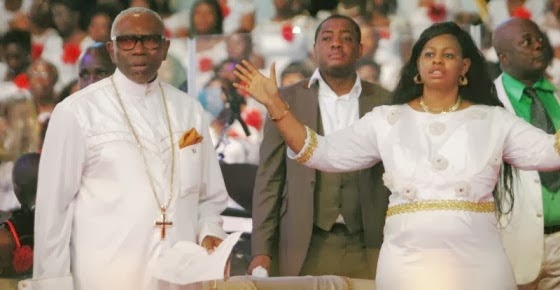
Pix Post: GEJ goes to Oritsejafor's Jubilee Festival in Warri.


  See more after the break.


Tuesday, 3 December 2013

CNN censorship scandal: western media (mis)reporting for NATO - interview


CNN has edited out part of an interview with Russian Ambassador to the United Nations Vitaly Churkin that focused on the situation in Syria. The final edition of Tuesday’s program hosted by Christiane Amanpour lacks his answers to some key questions relating to the settlement of the Syrian crisis. Afshin Rattansi, an award-winning journalist, who launched one of the Middle East's first international satellite TV stations, talked with our source about the controversial issue.


CNN has edited out part of an interview with Russian Ambassador to the United Nations Vitaly Churkin that focused on the situation in Syria. The final edition of Tuesday’s program hosted by Christiane Amanpour lacks his answers to some key questions relating to the settlement of the Syrian crisis. One of the questions cut out by CNN journalists concerned President Bashar al Assad’s role after the start of the transition period. “This is something for Syrians to decide”, Vitaly Churkin said in the full version of the interview posted on the website of the Russian Embassy to the United Nations.

He added that President Assad is supported by ‘a large segment of the Syrian population’. Therefore, Syrians should be allowed to decide what kind of path they need to bring the conflict to an end.

The US TV channel also dropped the diplomat’s remarks deploring any preconditions by the Syrian opposition for the Geneva Two peace conference. Mr.Churkin dismissed them as inadmissible.

Besides, CNN cut out the Ambassador’s statements on the Syrian opposition, which is trying to hamper humanitarian activities in the country. Vitaly Churkin said, specifically, that a high-level working party is currently holding consultations in Geneva to deal with the humanitarian situation in Syria.

The Ambassador also pointed to a curious fact that was also omitted in the final version of his interview. According to Mr.Churkin, every time people leave a besieged area, they move to the territories controlled by the government. In his opinion, this tells volumes about WHOM the Syrian population is relying on, including for providing humanitarian support.

First of all, could you comment briefly on the fact that the Russian diplomat’s interview was censored, and answers to some key questions were cut out? What’s your take on this?

It is another sign of disaster for mainstream media. The entire Syrian conflict has been covered on this particular network CNN in a drumbeat-to-war type of idea of journalism. Christiane Amanpour, of course it was her show that Vitaly Churckin’s remarks were cut from, this is obviously a kind of censorship Amanpour has formed during the Yugoslav war apparently, she is reputed to have walked out of Yugoslavia’s main TV network to have her makeup applied, knowing that NATO were going to bomb it, so she hasn’t changed, she presumably has a degree of blame being an anchor of this program, completely wrong as a matter of morality because of people’s lives in Syria, so many tens of thousands have died in this conflict and it is a matter of poor judgment with regard to journalism.

Why is this kind of censorship allowed? Does this mean that US media is actually not free?

Throughout the Syrian conflict and let alone the conflict in Libya, the big corporations that have been responsible and are responsible for the way most people in NATO countries get their news have done exactly what any Atlanticist, NATO supporting general or politician would want them to do. There is very little descent from the view that it is important for NATO to bomb countries into a subservient to their ideas of freedom, of their ideas of culture and their ideas of liberty. So, it is yet another example of the way media companies will deliberately try and subvert the message for their own purpose.

Is this the first time CNN is accused of censorship? Were there similar cases in the past?

I held a relatively senior role in the London office of CNN. I was a copy editor, the person last in charge of things going out on the CNN international news and it was obvious during my time with CNN that the journalists nearly copy and paste what they see on Reuters and other big news agencies. So, CNN news journalists they can’t be blamed for deliberately trying to subvert news, they just mainly drawn operators as it were doing copy and pasting what other agencies do.

However, when it comes to flagship programs like Amanpour this is obviously a case of editing out a senior United Nations diplomat for a purpose that it is clear, that in fact president Assad should have no role, that somehow Russia doesn’t believe he should have a role, and that there is no possible way that Al-Qaeda related rebels had been supported by CNN throughout the conflict.

CNN censors Russian Ambassador to UN assessment of Syrian rebel activities

The US CNN TV channel has dropped from its interview with the Russian Ambassador to the United Nations his appeal for the need to take into account the will of the Syrian people, who mostly support the incumbent President Bashar al-Assad, and also Churkin's statement that the Syrian opposition is stonewalling humanitarian activities, the ITAR-TASS news agency reports.

The interview is accessible on the CNN website. The final edition of the programme by a prominent host Christiane Amanpour lacks Churkin's answers to some key questions, one of which was about Assad's role after the start of the transition period.

"This is for Syrians to decide", Churkin said in the full version of the interview, which has been posted on the website of the Russian Embassy to the United Nations. According to Churkin, "the reality is that many Syrians, in fact the better part of the Syrian population, back up President Assad, and this should also be taken into account".

"So, let's launch a dialogue and make it possible for Syrians to make their own choice of the path towards ending the conflict", the diplomat said.

CNN has likewise dropped Vitaly Churkin's remarks that any preconditions by the Syrian opposition for the Geneva-2 conference are inadmissible. Geneva-2 is due to kick off on January 22nd . The opposition earlier made certain demands even when the date of the expected conference was only being agreed.

Vitaly Churkin deplored the fact in a conversation with the ITAR-TASS news agency that CNN had broadcast a downsized version of his interview. He claims that CNN has dropped "the more acute issues" of a Syrian settlement.

CNN has, besides, cut out the Russian Ambassador's assessment of the rebels' activities, as well as moves by the countries that support rebels as regards the provision of assistance for the population of Syria. The Russian diplomat said specifically that a high level working party is currently holding consultations in Geneva to react to the humanitarian situation in Syria.

Churkin also said that there is leverage over Damascus concerning humanitarian issues, but "nobody knows who actually influences the hundreds or at least dozens of armed groups" preventing humanitarian aid from reaching the Syrian population. "We must find out what these countries are, and they should assume responsibility for settling problems with the groups in question so the latter will not hinder the evacuation of the population from besieged areas. The opposition has prevented the evacuation of people from such areas on several occasions in recent months, whereas the government in Damascus was prepared to move people out", the Russian Ambassador to the UN said.

He also pointed out a curious fact that had also been dropped from the broadcast version of the interview. According to Churkin, "each time that the population leaves a besieged area, they move to territories under Syrian government control". "I think this speaks volumes about who the population pin their hopes on as regards the provision of humanitarian assistance", the diplomat said.

Alexei Mukhin, General Director of the Centre for Political Information in interview to our source said:

"The US media, probably, guided by patriotic considerations, are trying to support the country’s leadership, which, to put it mildly, has lost face during its efforts aimed at settling the Syrian crisis. And now it has got involved in the information confrontation with Russia, aiming to help Washington to save face. I believe that such moves – once the public, including the world public becomes aware of them - are compromising the US media, which are considered to be exemplary from the point of democracy and freedom of speech. I believe that such moves are doing damage to the US, undermining its reputation, which has already been tarnished."